TUTORIAL
The Amylo-Pipe server combines the next generation mechanistic and kineticHere are the details related to the pipeline:
Guidelines to use Amylo-Pipe
Home page
The prediction page can be accessed by following buttons:
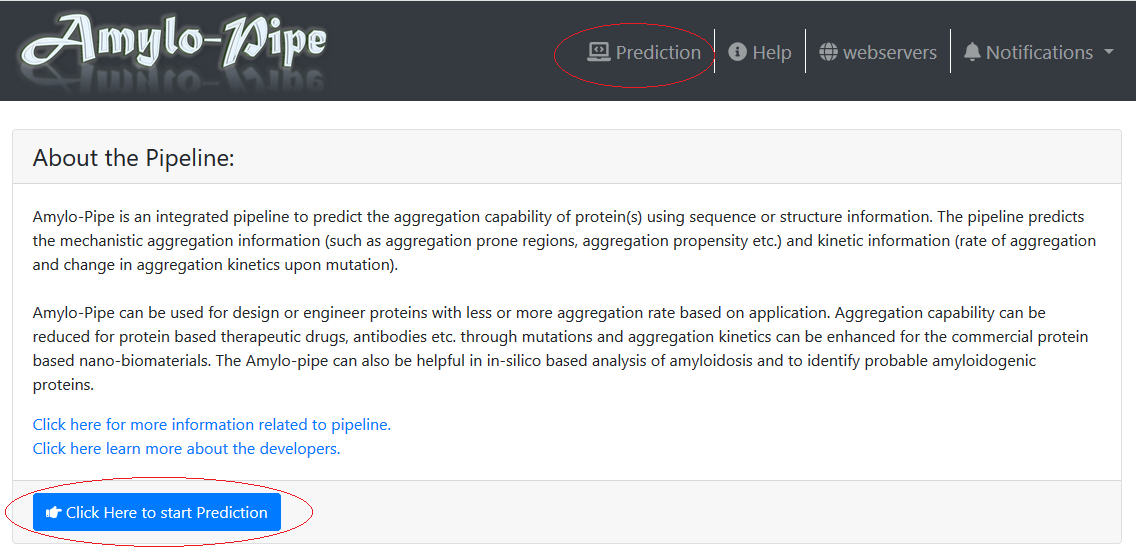
Prediction page
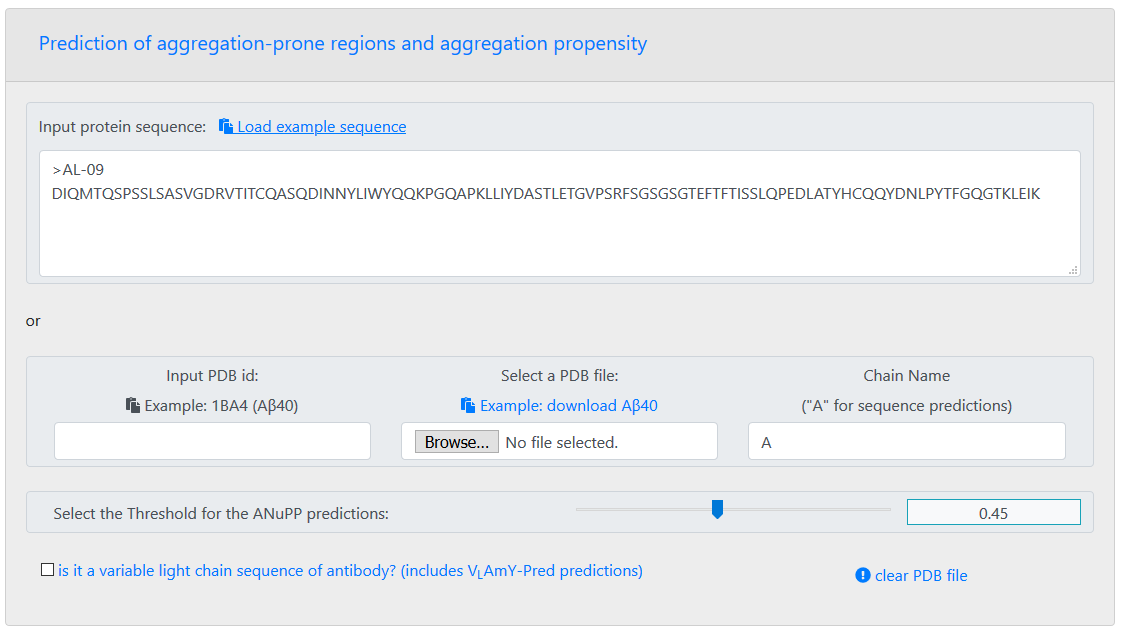
The prediction page is divided into 2 section:
(1) mechanistic prediction and
(2) kinetics prediction.
The mechanistic prediction by ANuPP gives the aggregation-prone regions and residue-wise aggregation propensity.
VLAmY-Pred is also a mechanistic prediction method, which can predict the amyloidogenic nature of the antibody light chain variable region.
The imputs required for the mechanistic prediction are (1) sequence in FASTA format or (2) PDB id of the structure or (3) Structure file of the protein in the PDB format. The chain identifier is "A" by default.
If the input sequence/structure is a variable light chain region of the antibody. Then users can select the corrosponding check box option.
Users can remove the input PDB file by "Clear PDB file" button
Prediction of aggregation kinetics is an optional drop down menu, which opens a new section of form.
The experimental condition and PSSM file are optional for the kinetics prediction. Preloaded PSSM file can significantly improve the loading time of result page. However, webserver automatically calculates PSSM profile if users do not have PSSM file.
The default parameters are most commonly used experimental conditions, which users can modify accordingly.
The checkbox allows users to specify their need for the kinetics prediction. The point mutation list column accepts multiple point mutations in [wild-type residue]-[position in structure(sequence position if structure not given)]-[mutant residue] format. Alternatively, users can check the "mutate all to gatekeeper residues (D,E,R,K,P)" option. This options will make point mutations for all non-gatekeeper residues.

Result page
The result page contains consolidated results from all webservers. The ANuPP predictions of aggregation propensity and APRs shows a graph and figure for sequence-based prediction. Similarly, VLAmY-Pred classifies the amyloidogenic/non-amyloidogenic sequence and provides the CDRs and FRs information.
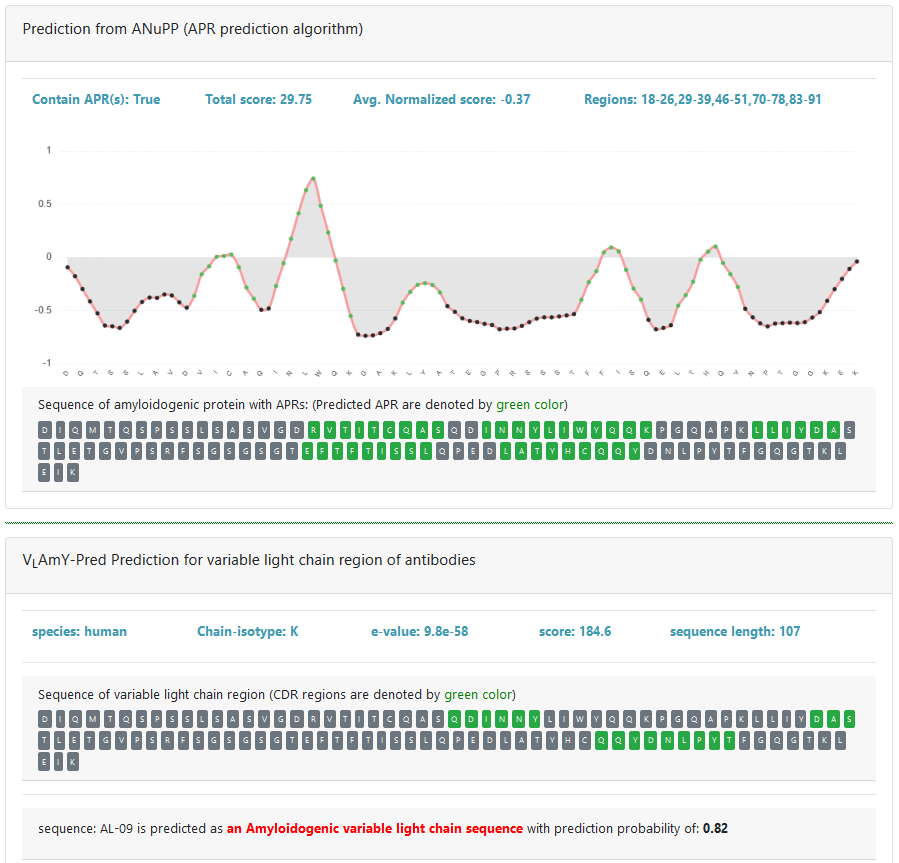
The structure-based prediction of ANuPP selects the APRs based on solvent exposure. It also provides the protein structure, where APRs can be viewed on the structure.

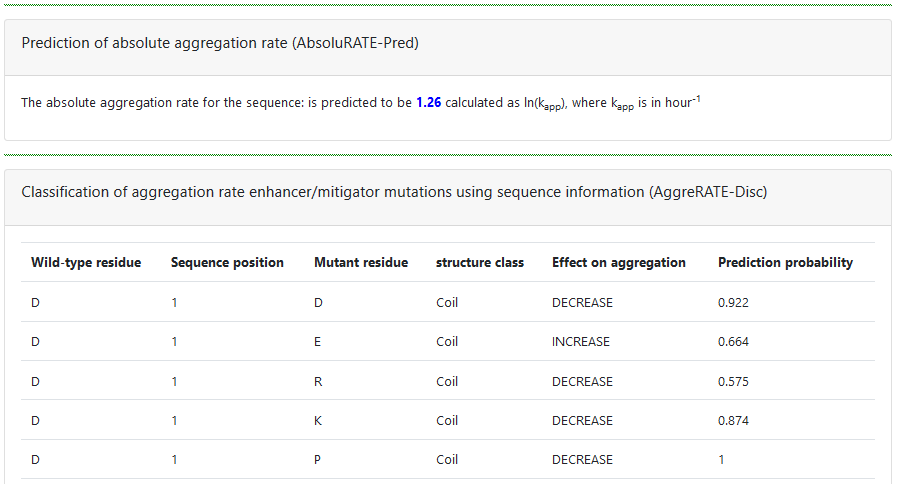
In the prediction of aggregation kinetics, the AbsoluRATE-Pred predicts the aggregation rate for the whole protein using sequence information.
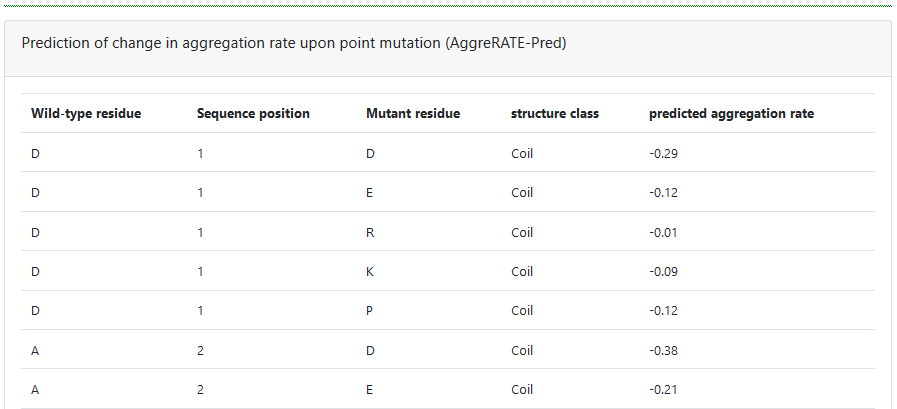
The point mutation result(s) are given seperately for sequence (effect on aggregation kinetics as increase or decrease) using AggreRATE-Disc and for structure (quantitative change in aggregation rate) using AggreRATE-Pred. The result for each mutation is shown in the table. In case of contradiction in sequence and structure-based results, we recommend to use the structure-based prediction results.
Sequence-based prediction (AggreRATE-Disc results)
Structure-based prediction (AggreRATE-Pred results)
Please contact the author, if you face any issue related to webserver or otherwise...
Webserver compatibility
Webserver is tested on windows/linux firefox 84.0, Windows Edge 87.0 and windows google chrome 87.0
ANuPP is a second generation machine-learning based mechanistic model to predict the aggregation-prone regions in proteins. It is based on atomistic features and applicable to both sequence and structure of protein.
Link to web server Link to paperVLAmY-Pred is a sequence-based machine-learning model,which can predict the amyloidogenic nature of antibody light chain variable region.
Link to web server Link to paperAbsoluRATE-Pred is a sequence-based machine-learning model, which can predict the absolute aggregation rates of native proteins or peptides.
Link to web server Link to paperAggreRATE-Disc is a sequence-based machine-learning model, which can classify the point mutations based on effect (increase/decrease) on aggregation rate.
Link to web server Link to paperAggreRATE-Pred is a structure-based regression model, which can quantitatively predict the change in aggregation rate upon point mutation.
Link to web server Link to paper